
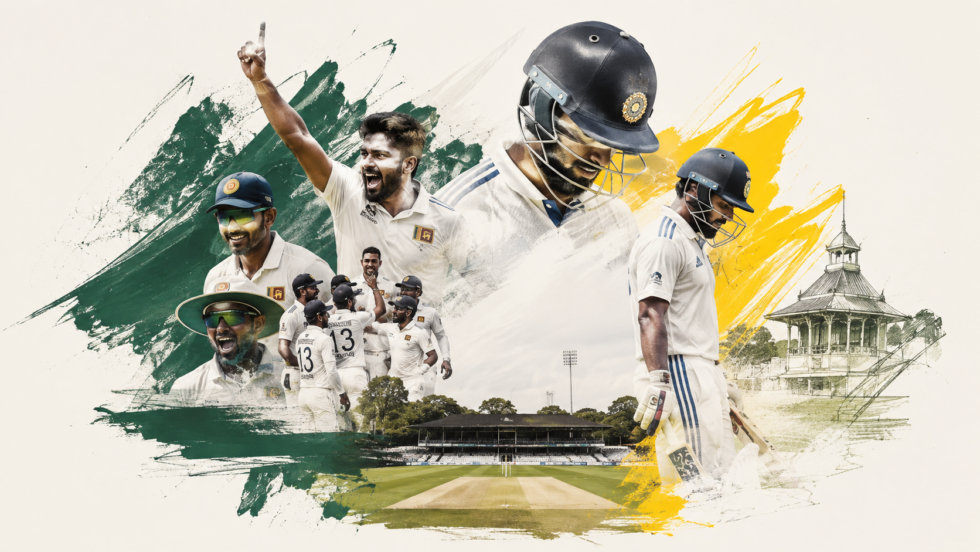
SL vs IND moved to Colombo on 23 August with India holding a 1-0 series lead, but the opening session of the second Test quickly produced a different contest from the one Shubman Gill's side controlled in Galle. Gill won the toss at the Sinhalese Sports Club and chose to bat, only for India to lose both openers before the 20-over mark. At 11.41am IST, India were 69 for two after 19.5 overs, with Devdutt Padikkal and Gill trying to rebuild after Lahiru Kumara made the first breakthrough and Asitha Fernando bowled Yashasvi Jaiswal for 45. Sri Lanka had also brought spin into the game early through Keshara Nuwantha and Prabath Jayasuriya, while increasingly heavy cloud gave their seamers encouragement shortly before lunch. The second Test is the final match of the two-game series and carries World Test Championship points as India seek a 2-0 win and Sri Lanka attempt to salvage a draw in the series, The WP Times reports for the Ashford Chronicle.
The morning also brought three Test debuts and an important change to India's attack. Saransh Jain, the 33-year-old off-spinning all-rounder from Madhya Pradesh, replaced Kuldeep Yadav after Gill confirmed the wrist-spinner was unavailable because of an infection; Sri Lanka handed first caps to Kamil Mishara and Pasindu Sooriyabandara as part of a batting reshuffle forced by injuries. Kusal Mendis is out with a serious hamstring problem, Dinesh Chandimal cannot play because of the mandatory stand-down following his concussion in Galle, and Pathum Nissanka remains unavailable while recovering from wrist surgery. Those absences leave Dhananjaya de Silva's side trying to level the series with a substantially altered top order against an India team that won the first Test by 165 runs.
The first 20 overs in Colombo did not settle the Test, but they did remove the assumption that India would simply transfer their Galle control to a traditionally good batting ground.
SL vs IND 2nd Test: Sri Lanka strike before India can settle
India's decision at the toss was orthodox. The SSC has a long history of rewarding sides that make first use of a sound surface, and this match is the 47th Test staged at the ground, making it one of Asia's most frequently used Test venues. Yet Sri Lanka found enough movement with the new ball to prevent Gill's side from establishing the kind of opening platform they wanted. Kumara struck first, and although Jaiswal counter-attacked with nine boundaries in a brisk 45, Fernando brought the ball back sharply from around the wicket, found the inside edge and hit the stumps at 66 for two.
The dismissal also produced the sharpest moment of the morning. Fernando gave Jaiswal a send-off, Jaiswal responded, and the pair moved towards one another before the situation was separated. It mattered more as a sign of Sri Lanka's intensity than as theatre: de Silva had spent the eve of the Test demanding more from his fast bowlers, and his two senior quicks had immediately placed India's top order under pressure.
Padikkal's start was considerably less secure. He was put down twice in his first few runs, first by Sonal Dinusha and then by de Silva off Nuwantha. By 13.3 overs he had survived two chances despite having barely begun his innings, a reminder of the opportunities Sri Lanka cannot afford to waste in a match they must win to square the series.
The early pattern was clear:
- Kumara supplied the higher pace and claimed India's first wicket.
- Fernando returned for a second spell and bowled Jaiswal for 45.
- Nuwantha was used before the 14th over and immediately found enough grip to create chances.
- Jayasuriya entered the attack before 20 overs, giving de Silva a second spin option while the ball was still relatively new.
- Cloud cover increased late in the morning session, improving the immediate conditions for seam bowling.
That last point matters at SSC. A Colombo Test can move through several different bowling conditions in the same day. A pitch that looks benign in bright sun can offer seamers a short spell of assistance under cloud, then ask spinners to do the bulk of the work as the surface dries and wears.
Why Colombo is a different Test from Galle
The change of venue alters almost every tactical calculation in india vs sri lanka. Galle is dominated visually and tactically by spin, with the sea, the fort and a surface that can become increasingly abrasive. SSC is flatter in character and more enclosed, sitting amid central Colombo with grass banks, modest stands and the city's skyline around it. The ground has generally allowed batters more time early in Tests, but its recent numbers do not support the idea that spin becomes secondary.
Spinners took 45 wickets across the three Tests at SSC immediately before this match, ten more than the fast bowlers. That explains why Sri Lanka were prepared to introduce Nuwantha and Jayasuriya so early on day one and why India were still comfortable replacing Kuldeep with another spinner rather than a seamer.
The difference is one of timing rather than category. In Galle, teams often expect spin to dictate the contest almost from the start. At SSC, the first two sessions can offer substantial value for batting if the new ball is negotiated, before slow bowling takes on greater influence.
| Match factor | First Test, Galle | Second Test, Colombo |
|---|---|---|
| Series position | 0-0 before play | India lead 1-0 |
| India first innings | 462 | In progress |
| Main Indian performer | Devdutt Padikkal 167 | Padikkal survived two early chances |
| Main Indian bowler | Manav Suthar, 10 wickets in match | Suthar retained |
| Sri Lanka objective | Establish series lead | Must win to level series |
| Surface profile | Spin became increasingly influential | Better early batting reputation, spin still important |
| Sri Lanka batting availability | Chandimal played before concussion | Mendis, Chandimal and Nissanka unavailable |
India's 165-run victory in Galle rested on more than the final margin. Padikkal made 167 and 44, KL Rahul scored 82 in the first innings, and Suthar collected his maiden ten-wicket Test match haul as Sri Lanka failed to chase 372. The ICC recorded India moving to fifth in the World Test Championship standings with a points percentage of 53.33 after that result, while Sri Lanka fell to sixth on 33.33.
For Sri Lanka, the problem in Colombo is not simply finding a better pitch. They have to find a better first innings.
Dhananjaya de Silva wants pace to matter in Sri Lanka
The most revealing discussion before sri lanka vs india centred on Sri Lanka's fast-bowling resources rather than their spinners. De Silva said he wants "two or three bowlers who can bowl at more than 140kph", because at present he sees only one such option in the Test set-up. His immediate pairing remains Fernando and Kumara: one built around control, the other selected partly for outright pace.
"Asitha's line and length is perfect, and Lahiru Kumara has the pace."
(Dhananjaya de Silva, speaking before the second Test against India in Colombo.)
The distinction is important. Fernando has become Sri Lanka's most dependable Test seamer without relying on extreme speed. His value is in repetition, seam position and the ability to make batters play. Kumara offers something less common in the Sri Lankan system: deliveries approaching and exceeding 140kph, with one ball on Sunday morning clocked at 138.2kph in his first spell.
Kumara came into this Test with 106 wickets from 36 Tests at an average a little above 36. His career has repeatedly been interrupted by injury, and he returned two for 104 in Galle. De Silva acknowledged that Sri Lanka have worked hard simply to keep him available.
"I'd also like for there to be two or three bowlers who can bowl at more than 140kph, but unfortunately we only have one bowler like that."
(Dhananjaya de Silva, Colombo, on Sri Lanka's Test fast-bowling depth.)
The broader numbers explain his frustration. In the previous 15 years, only one Sri Lankan fast bowler had taken a five-wicket innings haul in a Test at home: Nuwan Pradeep's six for 132 against India in 2017. Visiting seamers managed 14 five-wicket hauls in Sri Lanka over the same span, with Mitchell Starc and Junaid Khan doing so three times each.
De Silva's point is therefore not that Sri Lankan conditions cannot reward pace. His argument is that opposition quicks have repeatedly extracted more from those conditions than the home attack.
"Foreign pace bowlers have taken five wickets in Galle, for instance, but recently, none of our seamers have done that at Galle or SSC."
(Dhananjaya de Silva, before the Colombo Test.)
His captaincy has reflected that view. Sri Lanka once routinely selected only one specialist seamer at home, loading the attack with spin. De Silva has preferred two quicks, believing that a side capable of taking pace wickets in Sri Lanka will possess an attack transferable to other countries.
India vs Sri Lanka team news shaped by illness and injury
Sri Lanka's batting changes are not cosmetic. Three established names are unavailable, and Gary Kirsten's side have had to rebuild the top six during a series they are already losing.
Kusal Mendis sustained what Kirsten described as a "proper hamstring injury" during the Lanka Premier League and is expected to be absent for some time. Chandimal suffered concussion while fielding in Galle and is subject to the required seven-day stand-down. Nissanka is still recovering after wrist surgery in June.
Kirsten framed those absences as an opening for players with strong domestic records.
"We're missing a few guys from that perspective, but it creates a great opportunity for young players to come in and stake their claim."
(Gary Kirsten, after Sri Lanka's defeat in Galle.)
Mishara was called into the squad after a productive domestic run and was handed his first Test cap at SSC. Sooriyabandara, who had entered the first Test as Chandimal's concussion replacement, also received an official debut cap before the Colombo match. Sahan Arachchige was added to the squad after finishing as Sri Lanka A's leading run-scorer in the recent series against India A, although he was not selected in the XI.
India made only one change. Jain came in because Kuldeep was ill, not because India had abandoned wrist-spin on tactical grounds. The distinction matters because India's coaching staff had spoken before the Test about selecting combinations according to conditions rather than treating any individual bowler's place as automatic.
Jain's debut also changes the balance of the attack. He gives Gill an off-spinner against a Sri Lankan order containing several left-handers and lengthens the batting, while Jadeja and Suthar remain the two left-arm orthodox options.
Why Manav Suthar matters after Galle
Suthar arrives in Colombo as one of the series' defining players. He bowled 45.2 overs in the first Test, took ten wickets in the match and repeatedly attacked the same areas rather than searching for extravagant turn. His preparation had included deliberate work with the Kookaburra ball, which differs from the SG ball used in Indian home Tests.
After Galle, Suthar explained that India's spinners had focused on patience.
"We were discussing how patiently we needed to bowl because we knew it would be difficult for a new batter to play on this wicket."
(Manav Suthar, speaking to BCCI after India's Galle victory.)
That method is likely to be even more relevant at SSC. A flatter surface can punish a spinner who chases wickets. India can instead use Suthar, Jadeja and Jain to build pressure across long spells, particularly if the first innings extends into the second day.
What the Colombo Test means for the World Test Championship
This is not merely the last match of a short bilateral series. Both Tests form part of the 2025-27 ICC World Test Championship cycle. India entered Colombo fifth in the table after their Galle victory lifted them to 53.33 per cent; Sri Lanka were sixth on 33.33.
The arithmetic gives the sides different strategic requirements. India do not need to force a result to win the series, because a draw is enough for 1-0. Sri Lanka have no equivalent safety: only victory produces 1-1.
That difference can shape the game once the first innings totals become clear. A large Indian first innings would place Sri Lanka under pressure to score quickly enough to create winning time. A Sri Lankan first-innings lead would make Gill decide how much risk India should accept in pursuit of a clean sweep.
India also have the deeper recent reference point. Their win in Galle was their first match of this series but another result in a wider WTC campaign that still leaves little room for repeated defeats. KL Rahul said after the opener that the victory gave India confidence specifically because it came in spinning conditions, an area the batting group had been working on.
Sri Lanka's concern is more immediate. They have to construct an innings without Mendis, Chandimal or Nissanka against an attack that dismissed them for 284 and 206 in Galle.
The series score says India are ahead. The opening session at SSC showed that Sri Lanka have at least found a route into the deciding Test.
What is known after the opening phase of SL vs IND in Colombo
By 11.41am IST on the first morning, India were 69 for two after 19.5 overs. Jaiswal had made 45 before Fernando bowled him, Padikkal had survived two dropped chances, and Gill was still settling against a Sri Lanka attack that had already used four bowlers. Darker cloud had moved across the ground, making the final part of the morning session more appealing for Fernando and Kumara.
The next phase is straightforward. Sri Lanka need to turn early pressure into wickets before the conditions flatten and India reach Pant, Jadeja and the lower-middle order with a platform. India need Gill or Padikkal to produce the kind of long innings Padikkal played in Galle and force the hosts to spend several hours in the field.
For de Silva, there is also a more specific test of his pre-match argument. He asked Sri Lanka's quicks to raise their level by a few percentage points and argued that pace must retain a place in the country's home-Test strategy. Fernando's dismissal of Jaiswal and Kumara's opening breakthrough supplied an immediate answer, but the measure will be the score India reach before Sri Lanka have to bat.
Meta description: SL vs IND 2nd Test in Colombo: India lose both openers after choosing to bat as Sri Lanka's quicks strike early. Team news, SSC pitch, real quotes, injuries and WTC context from day one.
Follow Ashford Chronicle for daily news from Ashford and Kent — traffic, property, business and the decisions shaping the borough. Read more from Ashford Chronicle: How does the free travel pass work for Ashford families planning Kent trips in August 2026