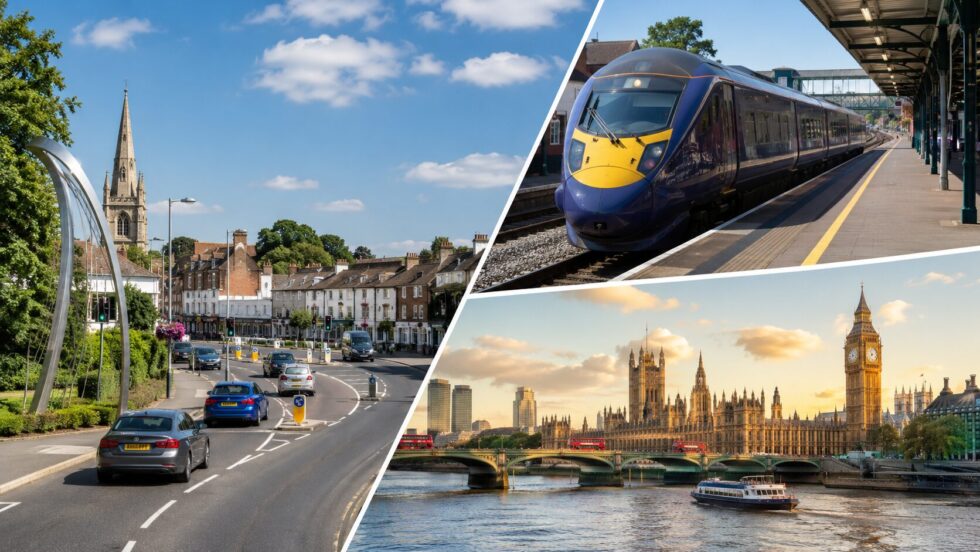
If you're travelling from Ashford this week — commuting into London, heading to the coast, or just getting around town — there's one change that matters more than any other: London Charing Cross and Waterloo East stations are closed for 22 days, from Sunday 26 July to Sunday 16 August 2026, for a £20 million track and platform upgrade. That means the whole of the target week falls inside the closure. The reassuring news is that routes into London stay open throughout, and Ashford is unusually well placed to cope, because its fastest link to the capital — the High Speed 1 Javelin service to London St Pancras — is not part of the closure and keeps running. This guide sets out exactly what's affected on the railways and the roads, with a particular focus on getting between Ashford and London, plus the local roadworks and diversions worth knowing about, the newsroom Ashford Chronicle reports.
A quick orientation before the detail. Ashford has three broad ways into London: the fast High Speed 1 Javelin to St Pancras from Ashford International; the classic South Eastern Main Line services that normally run to Charing Cross and Cannon Street; and the roads — principally the M20 to the M25 and on into the capital. This week, the High Speed line is your most reliable bet, the Charing Cross-bound classic services are diverted to other London terminals, and the M20 is running normally by day but carries the usual summer holiday pressures around the Kent ports. Let's take each in turn, starting with the railway, because that's where the biggest change lands.
The Big One: Charing Cross and Waterloo East Closed for 22 Days
From Sunday 26 July to Sunday 16 August 2026, no trains call at London Charing Cross or London Waterloo East. Network Rail and South Eastern Railway are using the 22-day window to replace nearly two kilometres of 36-year-old track — 1,800 metres of new rail and 16 sets of switches and crossings between Charing Cross and Waterloo East — as well as rebuilding sections of platform at Charing Cross, upgrading track drainage at Waterloo East and carrying out structural repairs to the pedestrian link bridge and to Hungerford Bridge over the Thames. The railway chose a single continuous 22-day closure rather than four separate nine-day closures spread over many months, on the basis that one longer block is less disruptive overall than repeated shorter ones.
The key message for Ashford passengers is that trains keep running and routes into London remain open — they're just different. Southeastern services that normally run into Charing Cross are diverted to London Victoria, London Cannon Street and London Blackfriars, with some services terminating at London Bridge. Journeys may take longer and involve different interchanges, so it's worth thinking ahead rather than turning up expecting the usual pattern.
Crucially, the Charing Cross Underground station is not affected and runs as normal — it's only the National Rail terminus above it that's closed. So if your final destination is around Charing Cross, Embankment or the West End, you travel to one of the alternative terminals and finish the journey on the Tube.
What This Means for Ashford's London Trains
Ashford sits on the South Eastern Main Line, and the classic (non-high-speed) services from Ashford towards London are the ones affected by the diversions. Here's how the main options break down for the week.
| Route from Ashford | What's happening this week |
|---|---|
| High Speed 1 (Javelin) to London St Pancras | Running as the fast, reliable option — not part of the Charing Cross closure |
| Classic services normally to Charing Cross | Diverted to Victoria, Cannon Street or Blackfriars; some terminate at London Bridge |
| Connections onward in London | Ticket acceptance on London Underground and buses at no extra cost |
The single most useful takeaway: if you want the simplest journey into London this week, take the High Speed 1 Javelin from Ashford International to St Pancras. It's the fastest service anyway — the Class 395 Javelins run at up to 140mph — and because it terminates at St Pancras rather than Charing Cross, it sidesteps the closure entirely. From St Pancras you have the Victoria, Northern, Piccadilly, Circle, Hammersmith & City and Metropolitan lines, plus Thameslink and the wider National Rail network, all under one roof.
Getting Around London During the Closure
To keep people moving, ticket acceptance is in place across alternative rail routes, the London Underground and London buses at no extra cost. In practice that means your Southeastern ticket lets you use reasonable Underground routes between the main South London terminals — London Bridge, Waterloo, Victoria, Blackfriars, Cannon Street, Elephant & Castle and Embankment — to complete your journey. Two particularly handy links: the Jubilee line connects London Bridge and Waterloo, and the Circle and District lines connect Victoria, Blackfriars or Cannon Street with Embankment (for Charing Cross).
South Eastern Railway offers a useful piece of advice for the closure that's worth repeating: don't automatically pick the fastest route in TfL Go or other journey planners. Look instead for an option with fewer changes and simpler interchanges, even if it takes a few minutes longer — it usually makes for a smoother, less stressful trip when the network is busy and unfamiliar. First and last train times also change during the closure, so check them to avoid being caught out late at night.
Late-Night Engineering: Buses Replace Trains Near Ashford
On top of the Charing Cross closure, there's separate overnight engineering work affecting Ashford's line during the week, specifically in the late evening. From Monday to Thursday, accessible buses replace trains between Maidstone East and Ashford International from around 23:05 (Monday to Wednesday) or 23:55 (Thursday) until the end of service. Some late London Victoria to Ashford services are also diverted to run via Sevenoaks, and a couple of late services run only as far as Maidstone East, with additional stops at Kemsing, East Malling and Barming.
For most daytime and evening travellers this won't matter, but if you're travelling home to Ashford late at night on a weekday, check your specific train — you may find the last leg is a replacement bus, which takes longer than the train. Replacement vehicles can also be busier than usual, so allow extra time.
Driving into London: The M20, the M25 and Operation Brock
For drivers, the main artery from Ashford towards London is the M20, which runs northwest to junction 3 near Maidstone and on to the M25 London orbital. This week the M20 is open and running normally by day, but there are two things Ashford drivers should keep in mind through the summer.
The first is Operation Brock. This is the contraflow system deployed on a roughly 13-mile stretch of the M20 between junction 8 (Maidstone) and junction 9 (Ashford) to manage lorry traffic heading for the Kent ports during busy holiday periods. When Brock is in place, the coastbound carriageway can carry queuing freight while other traffic uses a contraflow on the London-bound side, which reduces capacity and can slow journeys — particularly at peak holiday getaway times in late July and early August. Deploying or removing the barrier occasionally requires overnight closures of sections of the M20 with signed diversions; when that happens, drivers are advised to follow the diversion signs rather than their SatNav.
The second is the general summer holiday pressure. Late July and early August are peak times for cross-Channel traffic, and the combination of port-bound lorries, holiday traffic and any Brock deployment can make the M20 between Ashford and Maidstone slower than usual. If you're driving into London, allow extra time, travel outside the busiest windows where you can, and check National Highways' live traffic information before setting off.
Road Routes and Alternatives
| Journey | Main route | Notes for this week |
|---|---|---|
| Ashford to London (car) | M20 → M25 → into London | M20 open by day; watch for Operation Brock and holiday delays J8–J9 |
| Ashford to Maidstone | M20 westbound | Contraflow may be in place on the J8–J9 section |
| Ashford to the coast (Folkestone/Dover) | M20 eastbound / A20 | Standard summer traffic; check for overnight works |
| Local town journeys | A28, A20, A2070 | Check Kent County Council's roadworks map for local works |
A note for drivers: because central London driving involves the Congestion Charge and the Ultra Low Emission Zone (ULEZ), most Ashford residents heading into the capital find it far cheaper and easier to drive to a station and take the train — especially the High Speed service — than to drive all the way in. If you do drive in, check the current Congestion Charge and ULEZ rates and hours on the TfL website first.
Local Roads and Roadworks Around Ashford
For getting around Ashford itself and the surrounding area, the pattern this week is routine rather than exceptional — no single town-centre closure dominates, but there are always utility works and maintenance schemes rotating around the borough. National Highways looks after the motorways and major trunk roads (the M20 and its junctions), while Kent County Council is responsible for the local road network, including the A28, A20 and A2070 that thread through and around the town.
Because local works change week to week and can be added at short notice for emergencies, the most reliable approach is to check Kent County Council's roadworks map, which shows works, diversions and who's responsible for them across the next 12 months. National Highways' own daily closures page and live travel alerts cover the M20 and any overnight works on its junctions. A quick check of both before a longer local journey will flag anything relevant on your route.
For anyone travelling towards the Folkestone and Hythe direction on the A20, or towards Faversham and the M2 corridor, it's worth noting that overnight closures for maintenance (typically 8pm to 6am) are common on these routes in summer, with signed diversions in place. These rarely affect daytime travel but can add time to late-night journeys.
Cycling and Walking in and Around Ashford
For shorter local journeys, cycling and walking remain the simplest options and sidestep all of the rail and motorway disruption entirely. Ashford is a relatively compact town, and the station — Ashford International — sits just southeast of the town centre, within walking distance of the main shopping area and many residential districts. During the Charing Cross closure, South Eastern Railway is actively encouraging those who can to cycle or walk to complete shorter journeys at the London end, and the same logic applies locally: for a trip of a mile or two within Ashford, you'll often be quicker on foot or by bike than dealing with parking and traffic.
If you're combining cycling with the train, note that cycle spaces on the High Speed Javelin services are available on off-peak trains but limited, so check the operator's bike policy before you rely on taking a bike with you into London.
Quick Summary: The Week of 27 July to 2 August 2026
For those in a hurry, here are the key points at a glance:
- London Charing Cross and Waterloo East are closed for the whole week (Sunday 26 July to Sunday 16 August) for a £20m track upgrade. No trains call at either station.
- Trains still run and routes into London stay open. Charing Cross-bound services are diverted to Victoria, Cannon Street and Blackfriars, with some terminating at London Bridge.
- The High Speed 1 Javelin from Ashford International to St Pancras is not affected and is the simplest, fastest way into London this week.
- Ticket acceptance is in place on the Underground and London buses at no extra cost; the Charing Cross Underground station runs as normal.
- Late-night weekday engineering means buses replace trains between Maidstone East and Ashford International (Mon–Thu) — check last trains.
- The M20 is open by day but watch for Operation Brock and summer holiday delays on the J8–J9 (Maidstone–Ashford) section.
- Check Kent County Council's roadworks map and National Highways' daily closures for local and motorway works.
Frequently Asked Questions
Are trains from Ashford to London still running this week? Yes. Trains continue to run and routes into London remain open, but Charing Cross and Waterloo East are closed until 16 August, so Charing Cross-bound services are diverted to Victoria, Cannon Street or Blackfriars, with some terminating at London Bridge.
What's the easiest way into London from Ashford this week? The High Speed 1 Javelin from Ashford International to St Pancras. It's the fastest service and isn't affected by the Charing Cross closure, so it avoids the diversions entirely.
Can I still get to the Charing Cross area? Yes — the Charing Cross Underground station runs as normal. Travel to one of the alternative terminals (Victoria, Cannon Street, Blackfriars or London Bridge) and finish your journey on the Tube. Ticket acceptance on the Underground is free with your rail ticket.
Do I need a separate ticket for the Tube or replacement buses? No. Ticket acceptance is in place across the London Underground, London buses and alternative rail routes at no extra cost during the closure, and your rail ticket is valid on rail replacement bus services.
Is the M20 open? Yes, the M20 is open by day. Watch for Operation Brock (the lorry contraflow between junctions 8 and 9) and general summer holiday delays, and be aware that deploying or removing Brock can require signed overnight closures.
Are there late-night changes near Ashford? Yes. From Monday to Thursday, buses replace trains between Maidstone East and Ashford International from late evening until the end of service, and some late Victoria services are diverted via Sevenoaks. Check your specific last train.
Where can I check live updates? Use the National Rail Enquiries and Southeastern journey planners for trains, TfL Go and the TfL Journey Planner for travel within London, and National Highways' live traffic information plus Kent County Council's roadworks map for the roads. All can change at short notice, so check shortly before you travel.
Local news for Ashford and Kent — covering life, transport, business and current developments, clearly and accurately. See also: our guide to getting around Westminster this week for anyone heading into central London.
Follow Ashford Chronicle for daily news from Ashford and Kent — traffic, property, business and the decisions shaping the borough. Read more from Ashford Chronicle: Eurostar and Ashford International: what we know about the 2029 return and why it may not happen