
Ashford travellers driving to Dover in August 2026 should normally join the M20 coastbound at Junction 10a, continue past Junctions 11, 12 and 13, then remain on the A20 towards the Eastern Docks. This route begins east of the Operation Brock contraflow between Junctions 8 and 9, removing the slowest managed section from a journey that starts in or around Ashford. It does not bypass congestion close to Dover, where passenger traffic, freight controls and French border checks can still produce delays. The practical advantage is narrower but significant: motorists avoid driving west towards Junction 9 only to return through Brock, Ashford Chronicle reports.
The Kent and Medway Resilience Forum has scheduled the Brock barrier to remain between Junctions 8 and 9 until Monday 24 August. Passenger cars can use the contraflow when it is operating normally, but lanes are narrower and subject to lower speeds, while incidents or changes to the traffic plan can restrict eastbound non-port traffic. For most Ashford departures, the reliable plan is therefore A2070 to Junction 10a, M20 to Junction 13 and A20 to Dover, with enough time reserved for the final approach and terminal processing rather than an improvised diversion through Kent villages.
The route that avoids the worst M20 queues is not a remote back road: it is the main motorway joined at the correct Ashford junction.
Which M20 route should Ashford drivers take to Dover?
The preferred Ashford to Dover route starts with the A2070 Southern Orbital Road and its direct connection to M20 Junction 10a. From there, drivers should take the coastbound carriageway towards Folkestone, remain on the motorway through Junction 11 at Westenhanger and Junction 12 at Cheriton, and pass Junction 13 as the road becomes the A20. The final section runs through the Roundhill Tunnel and on towards Dover, where signs separate ferry-terminal traffic from local destinations.
Junction 10a is particularly useful for travellers starting in south or east Ashford, including areas reached through the A2070 corridor. Kent County Council describes the junction as the link between the M20 and the A2070 Southern Orbital Road, while its road classification confirms that the A20 continues from M20 Junction 13 to Dover. The Port of Dover also identifies the M20/A20 as the quickest and most direct approach for most traffic arriving from the west.
Drivers leaving central, north or west Ashford may find Junction 10 closer than Junction 10a. Junction 10 remains a legitimate coastbound entry point, particularly when local traffic around the A2070 is heavy. The difference is that Junction 10a gives southern Ashford traffic a direct motorway connection without crossing more of the town’s internal road network.
The route can be entered into navigation systems in this order:
- Take the A2070 towards M20 Junction 10a.
- Join the M20 coastbound for Folkestone and Dover.
- Continue through Junctions 11 and 12 without leaving for local shortcuts.
- Stay on the road as the M20 becomes the A20 after Junction 13.
- Follow permanent and temporary signs for the Port of Dover Eastern Docks.
| Route from Ashford | Main roads | Exposure to Brock | Best use |
|---|---|---|---|
| Junction 10a route | A2070, M20, A20 | Avoids Junctions 8–9 | Most south and east Ashford departures |
| Junction 10 route | Local Ashford roads, M20, A20 | Avoids Junctions 8–9 | Central or west Ashford when Junction 10 is nearer |
| Junction 9 route | M20 from west Ashford | Passes the Brock boundary | Only when live conditions make it clearly faster |
| Canterbury diversion | A28, A2 | Avoids the M20 | Incident-led alternative, not the normal choice |
The Canterbury option requires a substantial movement north before turning towards Dover on the A2. It may help when the M20 or A20 is closed after Ashford, but it is rarely a sensible preventive detour. A route that looks clear on a map can lose its advantage at Canterbury, Brenley Corner or the A2 approach to Dover.
“Please travel to the Ferry Terminal at the Eastern Docks, via main routes only.” (Port of Dover, summer getaway guidance)
That instruction matters because navigation applications may suggest the A260, Alkham Valley Road or small roads around Capel-le-Ferne when the A20 slows. Those roads have limited capacity, serve local communities and may be controlled during severe congestion. Remaining on the signed M20 route to Dover also keeps the vehicle within the official traffic-management system if authorities begin metering passenger arrivals.
Leaving the A20 because its estimated arrival time rises by a few minutes can place a car outside the managed route and create a longer delay at the next junction.
When should Ashford travellers leave during August?
A normal drive from Ashford to the Dover ferry terminal is relatively short, but the motorway journey is only one part of the calculation. August traffic concentrates around school-holiday weekends, Friday departures, Saturday morning sailings and the days around the late-summer bank holiday. Queueing can develop near Dover even when the M20 through Ashford is moving freely.
For a ferry journey, the departure time should be calculated backwards from the operator’s check-in deadline, not from the ship’s advertised sailing time. Travellers also need to account for French border controls, security, terminal traffic and any queue-release system operating on the A20. The Port of Dover currently instructs tourist passengers using the EES process to arrive at the Eastern Docks no more than two hours before departure. Its official page says the complete EES procedure has not yet been implemented for all tourist traffic, so passengers should follow the instructions supplied with their booking rather than assume that every vehicle will face the same process.
A workable August schedule should include:
- the operator’s published check-in window;
- 35 to 45 minutes for the Ashford–Dover road section in clear traffic;
- at least 30 minutes of additional road contingency on an ordinary holiday departure;
- a larger margin when warnings mention Dover TAP, passenger holding areas or an incident near Folkestone;
- time to refuel, charge the vehicle and organise documents before joining the motorway.
The extra margin should be added before departure from Ashford, not created by arriving excessively early at the port. Reaching Dover far ahead of the accepted check-in window can add vehicles to local traffic without guaranteeing earlier processing. The Port’s current EES guidance specifically says passengers should arrive no more than two hours before their ferry.
How Operation Brock affects August journey times
Operation Brock August traffic is managed between M20 Junctions 8 and 9, west of Ashford. The 2026 summer deployment began on 14 July and is due to remain until 24 August. Lorries can be held on the coastbound carriageway if the Dover TAP queue on the A20 fills, while other traffic continues through a contraflow on the London-bound side.
For a traveller beginning in Ashford and joining at Junction 10 or 10a, the fixed contraflow is behind the vehicle. That is why driving west to Junction 9 is usually counterproductive. It adds mileage and may place the car beside the eastern end of Brock, where lane changes and traffic merging can reduce speeds.
Brock’s location does not make the rest of the corridor queue-free. Traffic can still slow around Junction 11, the Eurotunnel exits near Folkestone, the Roundhill Tunnel and the A20 entry into Dover. If Dover TAP is active, freight vehicles may occupy a controlled lane on the A20 while passenger cars are directed onwards under temporary signs.
National Highways states that, under normal Brock operation, the contraflow remains open in both directions for non-port traffic. Its live status page also lists more restrictive modes in which eastbound non-port vehicles must follow diversions. That status should be checked on the morning of travel because the barrier’s presence and the road’s operational condition are not the same thing.
“The contraflow system reduces the chance of needing to close the Roundhill Tunnel due to queuing lorries.” (Simon Jones, KMRF Strategic Lead for Border Disruption, 6 July 2026)
The Roundhill Tunnel is the critical connection between Folkestone and the Dover approach. When freight queues reach sensitive points on the A20, traffic management is intended to protect that corridor. Passenger drivers should therefore follow lane signs even when a navigation application shows an apparently faster exit.
How to avoid Dover queues without taking risky shortcuts
There is no permanent road route from Ashford that bypasses every Dover ferry queue. The queue may form inside the port, at French controls, on the final A20 approach or because sailings have been disrupted. Switching from the M20/A20 to the A2 does not remove a terminal-processing delay; it merely changes the direction from which the same port is approached.
The most effective queue-avoidance decisions happen before the vehicle moves:
- Check the ferry operator for sailing and check-in changes.
- Check the National Highways Brock status and live M20 incidents.
- Check the Port of Dover travel feed for terminal conditions.
- Use Junction 10a unless live traffic shows a specific problem east of Ashford.
- Keep the A2 alternative for a confirmed closure or official diversion.
- Follow roadside instructions over the original satnav route.
The Port advises motorists to use only the M20/A20 or M2/A2 main approaches. This protects local roads and keeps port traffic on routes where queues can be controlled. It also reduces the risk of reaching a local road closure and being sent back towards the original queue.
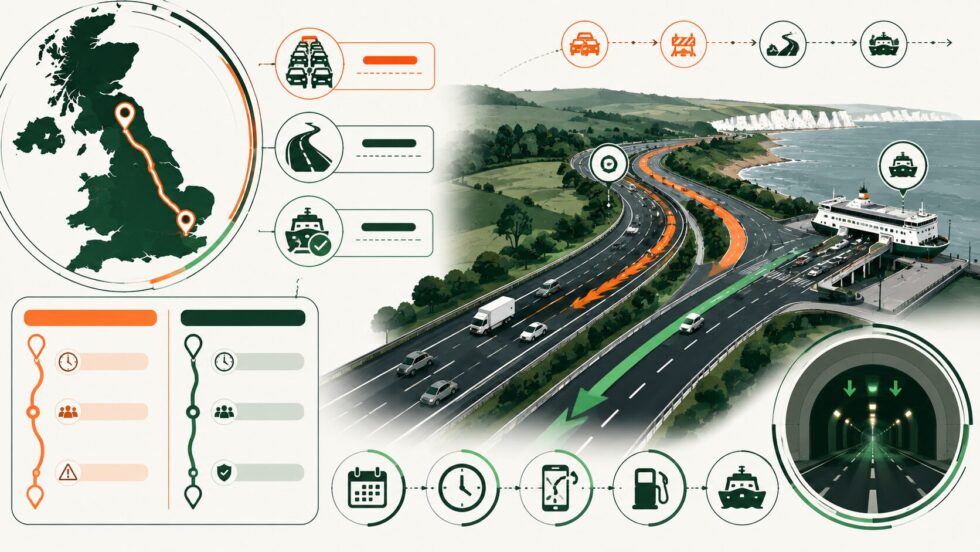
Drivers should not leave Ashford with an empty fuel tank or a low electric-vehicle charge. A routine 25-mile journey can become a prolonged stationary period during a major cross-Channel disruption. Water, food, essential medication and a charging cable should remain accessible rather than packed beneath luggage. Passports, ferry references and any documents for children, pets or the vehicle should be ready before the terminal booths.
Passenger traffic may be directed to Lydden Hill Race Circuit only in an extreme scenario. The Kent and Medway Resilience Forum has made the site available as a last-resort holding area during selected peak periods, but it is not a location motorists should enter independently or add as a planned stop. Vehicles would be sent there through official traffic controls.
An official holding area is part of the emergency plan, not an alternative car park for travellers trying to move ahead of a queue.
The longer-term pressure on the corridor is recognised by Kent County Council, which announced £20 million of government funding on 28 July for changes to Dover’s border facilities. The proposed work would add processing space and internal capacity equivalent to more than 500 lorries. KCC estimates that the scheme could reduce the frequency and duration of Brock and Dover TAP by up to 80 per cent during normal operations, but those changes do not alter the route required for August 2026.
“This project represents the beginning of the end for Operation Brock as we’ve come to know it.” (Peter Osborne, Kent County Council, 28 July 2026)
For the present summer, the decision remains straightforward. Ashford motorists should join the M20 east of Brock, preferably at Junction 10a via the A2070, stay on the M20/A20 and allow the spare time at the Dover end of the journey. The A2 should be treated as a live-incident alternative, not a guaranteed August shortcut.
Materials used: National Highways Operation Brock updates, Kent and Medway Resilience Forum summer 2026 notice, Port of Dover travel and EES guidance, Kent County Council road information and Dover access announcement.
Follow Ashford Chronicle for daily news from Ashford and Kent — traffic, property, business and the decisions shaping the borough. Read more from Ashford Chronicle: Eurostar and Ashford International: what we know about the 2029 return and why it may not happen