
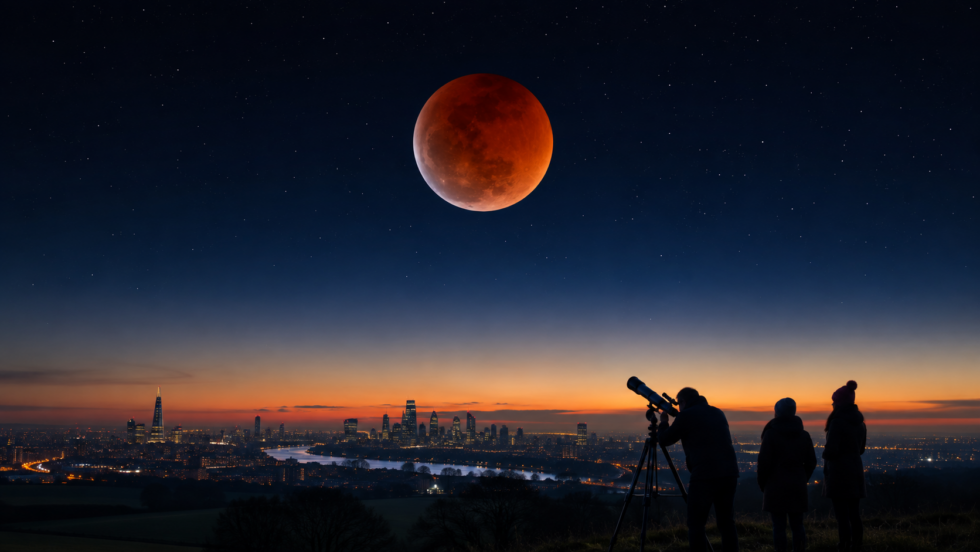
Friday 28 August 2026 will bring one of the year's strongest lunar eclipse displays to Kent, Ashford and London, but the best part arrives before most of south-east England is awake. The partial eclipse begins at 3.33am BST and reaches maximum at 5.12am, when roughly 93 per cent of the Moon's visible diameter will be inside Earth's dark umbral shadow. For observers in Ashford and elsewhere in Kent, as in London, the decisive practical detail is not simply getting outside before dawn: the Moon will already be descending towards the south-western and then western horizon, so buildings, mature trees, ridges and low cloud can hide it precisely when the eclipse becomes deepest. No eclipse glasses or other solar protection are needed. Ashford Chronicle is covering the event as a local viewing guide for south-east England, where location and cloud breaks will matter almost as much as the astronomical timetable.
Anyone planning how to watch 2026 lunar eclipse from Kent or Greater London should aim to be in position by about 3.20am rather than waiting for the 5.12am maximum. The first penumbral shading begins at 2.23am, but the more obvious phase starts at 3.33am when the Moon enters the umbra. From then until maximum, Earth's dark shadow progressively covers the lunar disc and the eclipsed area may take on a copper, brick-red or muted orange colour. London moonset is expected at about 6.15am, well before the formal partial eclipse ends at 6.51am, and locations elsewhere in the south-east will face the same basic problem of a Moon increasingly close to the horizon. Current Met Office guidance for London and south-east England also puts low pressure over the region from Wednesday to Friday, with heavy downpours and thunderstorms possible, making the latest cloud forecast on Thursday night more useful than any weather assumption made several days earlier.
The simplest plan for Kent, Ashford and London is to find an open western horizon before 3.30am and stay until the Moon becomes too low or dawn and cloud remove the view.
What time is the 2026 lunar eclipse in Kent, Ashford and London
The astronomical timings are effectively the same across Kent, Ashford and London because all three locations lie within a comparatively small part of south-east England. The Royal Observatory Greenwich gives 2.23am BST for the beginning of the penumbral phase, 3.33am for the beginning of the partial eclipse and 5.12am for maximum eclipse on Friday 28 August. The Moon then begins moving back out of the umbra, but this recovery is of limited practical importance for observers in the south-east because the Moon is setting. The formal partial phase ends at 6.51am, while London loses the Moon below the horizon at about 6.15am.
The difference between the penumbral and partial phases matters for anyone setting an alarm. At 2.23am, the Moon enters Earth's lighter outer shadow, and the first effect can be subtle enough to miss unless the sky is transparent and the observer knows what to look for. At 3.33am, the edge of the much darker umbra starts cutting into the lunar disc. From that point the event becomes unmistakably an eclipse rather than a slightly dimmed full Moon.
| Eclipse stage | UK time on 28 August | What viewers in Kent, Ashford and London can expect |
|---|---|---|
| Penumbral eclipse begins | 2.23am BST | Slight, initially subtle dimming of the Moon |
| Partial eclipse begins | 3.33am BST | Dark umbral shadow begins covering the lunar disc |
| Deep partial phase | 4.00am-5.00am | Increasingly large dark and potentially reddish area |
| Maximum eclipse | 5.12am BST | Roughly 93% of the Moon's diameter in the umbra |
| Dawn and low-Moon period | Around maximum onwards | Horizon, cloud and brightening sky become increasingly important |
| London moonset | About 6.15am BST | Eclipse disappears below the horizon |
| Partial eclipse formally ends | 6.51am BST | Not visible from London because the Moon has already set |
These are British Summer Time figures, so there is no need for residents in Kent or London to convert from UTC. The Royal Observatory notes that the principal eclipse phases occur at roughly the same time across the UK and Ireland, although Moon altitude and the exact time of moonset vary with location.
For lunar eclipse Kent searches, 5.12am is therefore the headline time but not the ideal starting time. Someone walking outside at 5.10am could find the Moon behind a neighbour's roof, a line of trees or a bank of low cloud and have almost no opportunity to change location. Arriving around 3.20am gives nearly two hours to watch the shadow deepen and provides time to adjust if the original site has a poor western outlook.
Ashford has the same timetable. The town's position farther east than London does not produce a meaningfully different eclipse phase time for a casual observer. What changes locally is the landscape: a garden with a blocked south-western view may be inferior to an open rural location only a few minutes away, while a higher site can remain useful later because the horizon is less obstructed.
London creates a different problem. The Moon itself is bright enough to overcome ordinary city light pollution, so the glow of the capital is not the main obstacle. Buildings are. An observer surrounded by six-storey blocks, office towers or mature street trees can lose the Moon well before astronomical moonset.
“You'll need to get to a high vantage point with a clear view towards the south-western horizon.”
(Royal Observatory Greenwich, guidance for the 28 August 2026 partial lunar eclipse.)
That advice applies particularly strongly close to maximum. Early in the event the Moon has more clearance above obstacles. By 5.12am, the object everyone is trying to see is both heavily eclipsed and low in the sky, a combination that rewards advance planning.
Where to watch the lunar eclipse in Ashford and across Kent
The best place for the lunar eclipse Ashford is not necessarily the darkest place available. For this event, an unobstructed south-west to west horizon is more valuable than travelling deep into the countryside purely to escape artificial lighting. The full Moon starts from such a high surface brightness that normal residential light pollution does not prevent the eclipse from being visible. Trees, buildings, hills, mist and cloud are much more serious obstacles. Ashford sits in a landscape where relatively short journeys can lead from built-up streets to open agricultural country. That gives residents an advantage if local cloud conditions permit. A broad field edge seen from a public right of way, a legal roadside stopping place with an open western aspect, or private land used with the owner's permission can offer a cleaner horizon than the centre of town. The aim should not be to reach the highest point on a map regardless of access. The useful site is the one that combines legal access, a safe route in darkness and a genuinely open view in the direction where the Moon will be descending.
A practical Ashford viewing check can be made in daylight on Thursday:
- Stand at the proposed location and identify the south-western and western horizon rather than assuming an open-looking site faces the correct way.
- Check for trees, rooftops, pylons and ridges that could block a Moon only a few degrees above the horizon.
- Confirm that overnight access is legal and that gates, car parks or paths will not be closed.
- Avoid narrow rural lanes where stopping a vehicle could create a hazard in darkness.
- Save a second observing site in a different direction in case local cloud or mist is concentrated over the first.
- Check the latest Met Office cloud and precipitation information shortly before leaving.
The same rules work across wider Kent, particularly where the landscape alternates between towns, woodland, farmland and higher ground. An apparently attractive wooded hill can be poor for a low lunar eclipse because the trees remove the horizon. A lower but open field-side position can be better. Coastal Kent may offer broad horizons, although the useful direction on this occasion is west and south-west rather than east over the Channel, so an east-facing beach is not automatically an advantage.
Darkness is helpful for comfort and photography, but a clean western horizon is the non-negotiable requirement for this eclipse.
A further consideration is the weather expected during the final week of August. The Met Office forecast issued on Monday 24 August says low pressure moving into London and south-east England from the south-west is expected to bring an unsettled Wednesday-to-Friday period, with heavy downpours and thunderstorms possible on each day. The Ashford forecast available on 24 August lists light showers for Friday, with a 50 per cent precipitation chance around 6am and gusts potentially reaching 32mph during the day. Those figures do not establish whether cloud will cover the Moon at 5.12am, but they are enough to make last-minute cloud checking essential.
A shower forecast can still produce usable eclipse conditions. Lunar observing does not require several consecutive hours of perfectly clear sky. A ten-minute opening near 4.45am or 5.10am can be enough for a strong naked-eye view or a useful photograph. The difficulty is that the Moon is low, meaning even a relatively narrow bank of cloud along the horizon can block it while much of the sky overhead remains clear.
How Ashford viewers should choose between town and countryside
Leaving Ashford town centre is worthwhile when buildings or trees close off the relevant horizon, not simply because the countryside is darker. A suburban garden with a broad western outlook can outperform a rural site surrounded by hedges.
Travelling also carries a cost. The eclipse begins in the middle of the night, and a remote destination may involve unlit paths, uneven ground, closed access or nowhere legal to park. There is little benefit in driving 30 minutes towards a theoretical viewpoint if the journey ends at a locked gate or a tree-lined path.
For most Ashford households, the decision can be reduced to three questions:
- Can the Moon be seen low in the south-west or west from home?
- Is there a legal, safer nearby location with a wider horizon?
- Does the latest cloud map favour one side of Ashford over another?
If the first answer is yes, staying close to home has considerable value. An eclipse that lasts for hours does not require an expedition.
Where to watch the 2026 lunar eclipse in London
The central issue for lunar eclipse London viewing is line of sight. London has considerable skyglow, but the Moon is bright enough for the eclipse to remain visible from the city. The strongest advantage therefore comes from height and space rather than extreme darkness. Open parks, elevated ground and broad riverside perspectives can be useful in principle, but overnight access must be checked before travelling. Many London parks have gates or closing hours, and a familiar daytime viewpoint cannot be assumed to be available at 4am. Private rooftops should only be used with proper access and permission. Railway platforms, bridges and roads are not substitutes for designated observing space.
The Royal Observatory Greenwich uses London as its reference location and says the Moon will become progressively lower as the eclipse develops. Maximum occurs at 5.12am, and the Moon sets at about 6.15am. Its recommendation for a high point and an unobstructed south-western horizon is therefore more relevant than simply finding somewhere with fewer street lamps.
Central London residents should examine the skyline carefully. The western view from a street can be blocked by buildings even when a large area of sky is visible overhead. Moving to the edge of an open square or other lawful open space may gain enough horizon to keep the Moon visible for another 20 or 30 minutes. In outer London, residential gardens and parks can provide broader sightlines, but trees become a major August problem because they are still in full leaf.
The River Thames can provide longer sightlines in some locations, but the river bends repeatedly through London. A waterfront position is only useful if the open direction matches the Moon's actual position. Being beside water does not automatically create a western horizon.
Why Greenwich is useful for the timings but not automatically the only place to watch
The Royal Observatory Greenwich is Britain's natural reference point for astronomical information, and its published timetable is the clearest source for this eclipse. That does not mean every London observer must travel to Greenwich.
A low lunar eclipse depends strongly on the observer's immediate horizon. Someone in west London with a clear elevated south-western view may have a simpler observing setup than someone travelling across the capital towards a famous astronomical site. Public transport is also much more limited before dawn than during normal hours, making unnecessary cross-city journeys impractical. The most efficient London plan is local. Find a legal viewing position close to home, check the horizon in advance and use the Observatory's timetable rather than treating Greenwich itself as a compulsory destination.
“No special glasses are required to view this eclipse; it's as safe as looking at the full Moon.”
(Royal Observatory Greenwich.)
The safety distinction is important because August 2026 has also featured solar-eclipse interest. Solar and lunar eclipse rules are not interchangeable. Looking directly at the Sun can damage eyesight and requires proper protection outside totality; watching the Moon during a lunar eclipse does not.
Why the August 2026 eclipse will look almost total
The 28 August event is classified as a partial lunar eclipse, yet its appearance around maximum should be much closer to totality than the word “partial” can suggest. At 5.12am in Britain, roughly 93 per cent of the Moon's diameter is expected to lie within Earth's umbra, the dark central part of the planet's shadow. NASA's eclipse visualisation describes an extremely deep partial event, with 96.3 per cent of the lunar disc area within the umbra at greatest eclipse. The percentages differ because they describe different geometrical measurements, not because the organisations disagree about the event.
The partial lunar eclipse UK will therefore leave only a comparatively narrow part of the Moon directly illuminated. Most of the visible disc can become much darker and take on a reddish or copper tone.
A lunar eclipse happens when the Sun, Earth and Moon line up closely enough for the Moon to pass through Earth's shadow. Earth's shadow has two main components relevant here. The penumbra is the lighter outer region, where only part of the Sun is blocked. The umbra is the darker central region, where direct sunlight is cut off.
At 2.23am, the Moon begins entering the penumbra. The effect initially resembles gentle shading. At 3.33am, part of the Moon reaches the umbra, creating the hard-edged darkness associated with a partial lunar eclipse. Over the next 99 minutes, progressively more of the disc is swallowed by the umbra until maximum at 5.12am. The darkened Moon is not necessarily black because Earth's atmosphere redirects some sunlight into the shadow. Sunlight passing through the atmosphere is scattered and filtered. Blue light is scattered more strongly, while red and orange wavelengths are more effective at reaching the shadowed Moon.
The result is the same broad optical reason sunsets can look red, seen on a planetary scale. From the Moon during a lunar eclipse, Earth would appear to block the Sun while the edge of the planet glowed with the combined light of sunrises and sunsets around the terrestrial atmosphere.
That filtered illumination explains why blood moon 2026 may appear in search results and social-media descriptions of the August event. The phrase “blood moon” is informal rather than an astronomical classification. More importantly, this is not a total lunar eclipse. A small bright section of the Moon remains outside the umbra at maximum.
The most distinctive view may be the contrast itself: a thin bright portion beside a much larger copper or rust-coloured eclipsed surface.
Colour cannot be predicted as precisely as eclipse geometry. Dust, aerosols, cloud and other conditions in Earth's atmosphere affect how much filtered light reaches the Moon. One eclipse can appear orange-red while another looks considerably darker. Local conditions add another layer. Haze close to Kent's western horizon can make the already eclipsed Moon look dimmer and redder. Thin cloud may still allow it to show through, while thicker cloud can remove it completely.
What the weather forecast means for Kent, Ashford and London
Weather is the largest remaining uncertainty for Friday morning. Astronomers can calculate the shadow geometry years in advance, but whether a particular street in Ashford or London has a clear Moon at 5.12am depends on the atmosphere over south-east England that morning.
As of Monday 24 August, the Met Office regional forecast for London and south-east England expects low pressure to move in from the south-west between Wednesday and Friday. It says heavy downpours and thunderstorms are likely on each day of that unsettled period. The site-specific forecast for London lists light showers on Friday and a 50 per cent rain chance around 6am; Ashford's forecast also lists light showers and a 50 per cent chance around 6am.
Those numbers should not be read as a 50 per cent probability that the eclipse itself will be invisible. A precipitation percentage is not a direct cloud-cover forecast, and conditions can vary considerably across Kent and Greater London.
For eclipse watching, three weather variables matter:
- low and medium cloud in the western and south-western sky;
- visibility and haze close to the horizon;
- showers capable of moving across the viewing direction around 3.30am-5.30am.
Wind matters mainly for comfort and photography. A gusty morning can shake a tripod or long telephoto lens even when the Moon is plainly visible.
The most useful forecast check should therefore happen late on Thursday 27 August and again shortly before departure. The Met Office London and South East England forecast gives the regional picture, while its local forecasts can show short-term differences between London and Ashford. The Met Office also provides a cloud-cover map extending several days ahead.
A completely overcast forecast would make a long journey difficult to justify. Broken cloud is different. Because the eclipse evolves slowly, observers have repeated opportunities for gaps to cross the Moon.
What to do if Ashford is cloudy but London is clearer
The temptation with an astronomical event is to chase clear sky. For a low pre-dawn eclipse, this should be done conservatively.
Kent to London is not a trivial cloud-chasing journey in the middle of the night, particularly if thunderstorms or heavy showers remain possible. A forecast difference needs to be substantial before a long drive makes sense. A nearby shift of five or ten miles towards a clearer part of Kent can be more practical than trying to cross the entire region.
Radar and satellite-style cloud information shortly before 3am will be more useful than a broad four-day forecast. If Ashford has broken cloud moving quickly, remaining locally may provide several viewing windows before maximum. The same principle works inside London. A bank of cloud over one part of the capital does not mean identical conditions everywhere, but travelling across London at 4am is rarely efficient unless a clear destination and transport plan already exist.
How to watch the lunar eclipse safely without specialist equipment
A lunar eclipse is one of the easiest major astronomical events to observe. The naked eye is enough. There is no requirement for eclipse glasses, welding filters or specialist solar viewers because the observer is looking at reflected sunlight from the Moon rather than directly at the Sun.
Binoculars improve the experience substantially. Even inexpensive 7x or 10x binoculars can show the boundary between the dark umbra and the remaining illuminated lunar surface more clearly. They can also reveal colour differences that are less obvious with the unaided eye.
A telescope provides greater magnification but is not essential. In fact, a very high-powered telescope can remove some of the visual impact because the eclipse is a whole-Moon phenomenon. A low-power eyepiece capable of fitting most or all of the lunar disc into the field of view is usually more useful.
The equipment list can remain short:
- warm or waterproof clothing suited to the latest forecast;
- binoculars if available;
- a phone with screen brightness reduced;
- a tripod for photography;
- a torch for safely moving around an unlit location;
- a weatherproof layer or cover for camera equipment if showers are possible.
Red-light torches are popular among astronomers because they preserve dark adaptation, but dark adaptation is less critical for observing a bright full Moon than for faint galaxies or meteor showers. Safety on a rural Kent path matters more than maintaining perfect night vision.
What not to bring
Solar eclipse glasses are unnecessary and will make the Moon extremely difficult or impossible to see. They are designed to block nearly all visible light when observing the Sun.
There is also no need to buy a powerful telescope specifically for Friday morning. The defining features of the eclipse, including the advancing umbral shadow and red colour, are visible without magnification.
The more useful investment is time spent checking the horizon.
How to photograph the lunar eclipse from Kent, Ashford or London
Photographers face an unusual combination on 28 August: the Moon will be becoming darker as the eclipse deepens, while the terrestrial sky simultaneously becomes brighter towards dawn. The Moon will also be low enough for landscapes, trees, rooftops and London's skyline to be incorporated into compositions.
A mobile phone can record the eclipse, but expectations need to be realistic. A phone's normal wide camera will render the Moon as a small object. Pinch-to-zoom digital magnification does not create the detail of a long optical lens and can produce a soft, overprocessed result.
A phone can work better when mounted securely behind a telescope or binocular eyepiece, although alignment can be awkward. Night modes designed for static landscapes may also blur the Moon because the lunar surface moves across the sky during long exposures.
A camera with a telephoto lens gives more control. The exact exposure depends on the lens, sensor, atmosphere and eclipse phase, so one fixed recipe cannot cover the entire event.
A useful method is:
- Mount the camera on a stable tripod.
- Switch to manual focus and focus carefully on the lunar surface.
- Use a shutter delay or remote release to reduce vibration.
- Photograph the Moon before the partial phase to establish focus and framing.
- Reduce exposure enough to preserve detail in the bright portion.
- Increase exposure progressively as the eclipsed area becomes darker.
- Bracket several exposures near maximum.
- Review sharpness at high magnification rather than relying on the small rear screen.
The large brightness difference across the Moon near maximum can exceed what a single exposure records comfortably. A setting that reveals the copper shadow may burn the remaining bright crescent to white. A shorter exposure preserving the bright portion can leave the eclipsed region almost black. Bracketing is therefore more valuable than searching for one perfect setting.
Kent offers opportunities for a low Moon over rural foregrounds. London offers buildings, bridges and skyline elements. In both cases, planning the Moon's direction is crucial because a telephoto lens has a narrow field of view. A long lens also exaggerates the apparent size of the Moon relative to distant foreground objects through perspective compression. That is why familiar photographs can show an enormous Moon behind a building or ridge. The effect does not mean the Moon itself was unusually huge; it results from photographing a distant foreground feature from farther away with a long focal length.
For the 2026 eclipse, the low altitude that complicates observing may become an advantage for photographers who want a landscape rather than an isolated lunar close-up.
Photographing from London
The best London photograph may not come from the darkest location. A long western sightline towards an identifiable skyline feature can produce a more distinctive image than a technically cleaner Moon against empty sky.
However, the location needs to be chosen from the geometry backwards. First determine where the Moon will be. Then find a legal, accessible place where the intended foreground lies in roughly the same direction. A beautiful east-facing skyline is irrelevant when the eclipsed Moon is setting in the west.
Tripod use also requires practical judgement in public places. Do not block paths or create a trip hazard in low light.
Photographing from Ashford and Kent
Ashford's lower-density surroundings provide more freedom to use hedges, fields, isolated trees or distant ridges as foregrounds. A photographer does not necessarily need to travel far from town.
A 70-200mm lens can frame the Moon within a broader scene, while 300mm and longer focal lengths make lunar detail more prominent. Very long lenses require a sturdy tripod, particularly if the Met Office's current indication of gustier Friday conditions persists.
Dew and shower moisture are another consideration. Lens cloths and a simple rain cover can prevent an otherwise usable cloud gap being lost to water on the front element.
Why Kent and London will see the same eclipse differently
Astronomically, Kent, Ashford and London are witnessing the same event. The percentage of the Moon within Earth's shadow does not materially change between them. The visual experience can still be quite different.
London has more artificial light, more high buildings and denser tree-lined streets. Ashford has easier access to open countryside but more potential for hedges, local hills and rural mist. Coastal Kent may have open views but is not automatically ideal because the required direction is towards the land-facing western side from much of the east coast.
The morning sky also changes throughout the event. When the partial phase starts at 3.33am, south-east England remains much darker. By maximum at 5.12am, dawn is advancing. The eclipsed part of the Moon is dimmer just as the background sky becomes brighter.
That gives the 2026 eclipse a different character from a high, midnight lunar eclipse. Its best phase is pressed against the beginning of morning.
NASA's visualisation of the 28 August 2026 lunar eclipse shows the global geometry and the progression of Earth's shadow across the Moon. The Royal Observatory Greenwich's UK eclipse guide translates that geometry into the practical problem facing British observers: an eclipsed Moon approaching the horizon before sunrise.
The eclipse belongs to a recurring Saros family, a sequence produced because the relative geometry of the Sun, Earth and Moon repeats approximately every 18 years and 11 days. Individual eclipses within a Saros series change gradually from one occurrence to another as the Moon's route through Earth's shadow shifts.
For the person standing in a Kent garden at 4.45am, however, none of that complexity needs to be calculated. The visible result is direct: the full Moon becomes progressively consumed by Earth's shadow.
The exact viewing plan for Friday morning
For anyone who wants a simple timetable rather than staying outside throughout the entire eclipse, the useful window can be divided into four periods.
2.23am to 3.30am: subtle penumbral phase
Only committed observers need to start this early. The Moon enters the lighter penumbral shadow at 2.23am, and the initial darkening is restrained.
The main value of going out before 3am is preparation. It gives photographers time to focus, test exposures and identify any obstruction before the umbral eclipse begins.
3.33am to 4.15am: the obvious eclipse begins
At 3.33am, the Moon starts entering the umbra. This is the point when casual observers should be able to see a clearly defined dark section growing across the disc.
For families or anyone unwilling to stay outside for hours, this period already provides a convincing view of a lunar eclipse without waiting until dawn.
4.15am to 5.12am: the strongest viewing period
This is the hour to prioritise. Most of the Moon moves into Earth's dark shadow and the colour contrast should become increasingly apparent.
Anyone in Ashford, Kent or London who plans to take only one set of photographs should aim to be ready before 5am rather than arrive at maximum.
From 5.12am until moonset: maximum against dawn
Maximum occurs at 5.12am. Roughly 93 per cent of the lunar diameter is within the umbra, making the event appear close to a total eclipse.
After maximum, the geometry slowly reverses, but British observers are racing the horizon. London moonset comes at about 6.15am, and the Moon becomes increasingly difficult to see as it descends and the sky brightens.
“The Moon will be low in the sky throughout, so you'll want a clear view towards the western horizon.”
(Royal Observatory Greenwich, August 2026 night-sky guidance.)
That is the single most important local instruction for Friday.
What people in Kent and London should check on Thursday night
The final decision should be made with current conditions rather than today's forecast alone. By Thursday evening, short-range cloud guidance should give a much clearer picture of where gaps may occur across Kent and London.
Check the following before setting an alarm:
- cloud cover between roughly 3am and 6am;
- rain radar and the expected movement of showers;
- wind if using a tripod;
- legal overnight access to the chosen location;
- road or rail arrangements if travelling;
- the western horizon from the exact observing point.
Do not rely on a forecast icon showing a cloud or raindrop for the entire day. The eclipse occupies a specific part of the morning, and short-lived clear intervals can make the difference.
The current Met Office outlook is not ideal but neither does it establish that the eclipse will be lost. Its Monday forecast describes an unsettled south-east with possible heavy downpours and thunderstorms from Wednesday through Friday. Site forecasts for both Ashford and London currently show shower risk on Friday.
For observers deciding between Kent and London, cloud should take precedence over light pollution. A clear London sky is better for this event than an overcast dark-sky site in rural Kent.
FAQ about the 2026 lunar eclipse in Kent, Ashford and London
What date is the lunar eclipse in the UK?
The eclipse takes place in the early hours of Friday 28 August 2026. The visually obvious partial phase starts at 3.33am BST and maximum occurs at 5.12am.
What time should people in Ashford get up?
Around 3am is a sensible alarm time if the aim is to see the full development of the partial phase. Being at the observing location by about 3.20am gives time to settle before the umbral eclipse begins at 3.33am.
Anyone interested mainly in maximum should still aim to arrive before 4.45am. Waiting until 5.12am risks losing the view to a low horizon or temporary cloud.
Where should people in Kent look?
Look towards the south-west and then progressively farther west as the Moon descends. The exact direction changes during the morning, but an open south-western to western horizon is the requirement highlighted by the Royal Observatory Greenwich.
Will London be too bright to see the eclipse?
No. City light pollution does not prevent a lunar eclipse from being seen because the Moon is a bright object. Buildings, trees, cloud and the low horizon are more important limitations for London observers.
Will this be a total lunar eclipse?
No. It is a deep partial lunar eclipse. At maximum, roughly 93 per cent of the Moon's diameter will be inside Earth's umbra, leaving a narrow section outside the darkest shadow.
Will the Moon turn red?
Much of the eclipsed surface may appear copper, orange-red or muted brown because sunlight passing through Earth's atmosphere is filtered and refracted into the shadow. The exact colour and brightness depend partly on atmospheric conditions.
Are eclipse glasses needed?
No. Lunar eclipses are safe to watch directly with the naked eye, binoculars or a telescope. Solar eclipse glasses are not required.
Can the eclipse be photographed with a phone?
Yes, but the Moon will usually appear small with a standard phone lens. A stable support and optical telephoto camera produce better detail. Digital zoom alone cannot reproduce the reach of a long lens.
What happens if it is cloudy at 5.12am?
Cloud can block the maximum, but the eclipse has a long useful observing window. Gaps between roughly 3.33am and 5.12am can still reveal a progressively deeper eclipse. Local cloud conditions should be checked shortly before departure.
Is Ashford better than London for viewing?
Neither location is automatically better. Ashford generally offers easier access to open countryside, while London has more buildings but can still provide excellent views from legal positions with broad western sightlines. On the morning itself, cloud and the immediate horizon can outweigh the difference between town and countryside.
The practical target for Kent, Ashford and London is therefore fixed: be ready before 3.33am BST on Friday 28 August, keep the south-western and western horizon clear and prioritise the hour leading to the 5.12am maximum. The eclipse needs no specialist protection and almost no equipment, but its low position means poor site selection can hide a spectacle that would otherwise be visible across the whole region.
Materials used: Royal Observatory Greenwich, NASA Scientific Visualization Studio, Met Office.
Follow Ashford Chronicle for daily news from Ashford and Kent — traffic, property, business and the decisions shaping the borough. Read more from Ashford Chronicle: How does the free travel pass work for Ashford families planning Kent trips in August 2026