
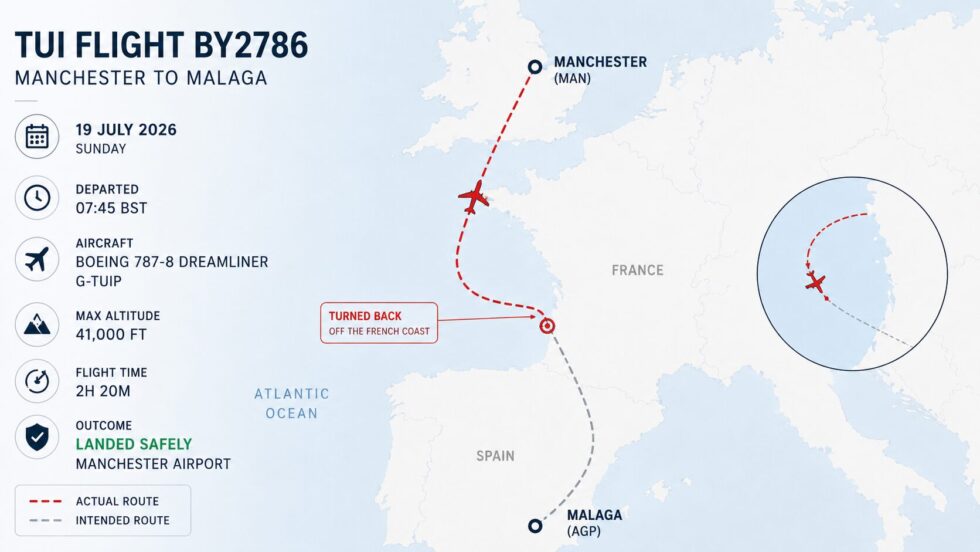
Sunday, 19 July 2026 — A TUI Airways flight from Manchester to Malaga returned to Manchester Airport after the crew turned the Boeing 787-8 Dreamliner back while flying near the western coast of France. The aircraft, registered G-TUIP, landed safely after abandoning the journey to Spain, with no injuries, emergency evacuation or abnormal landing reported, Ashford Chronicle reports, citing British news reports and publicly available flight-tracking data.
TUI Airways has not publicly confirmed the precise reason for the turnaround. Reports suggested that a possible technical issue may have influenced the crew’s decision, although neither the airline nor a UK aviation authority has identified a specific fault or confirmed that any particular aircraft system was affected. The available evidence therefore supports describing the return as precautionary rather than presenting a technical failure as an established fact.
Why the aircraft turned back
The reason for the turnaround has not been publicly confirmed. TUI Airways has not issued a statement identifying a technical or operational fault, and no UK aviation authority has released details explaining why the crew decided to discontinue the flight. While aviation outlet AIRLIVE reported that early indications pointed to a possible technical issue, that has not been verified by the airline or regulators.
That distinction is significant. A suspected technical issue is not the same as a confirmed mechanical failure. No publicly available information reviewed for this report indicates that the crew declared a mayday, that emergency services were required on arrival or that any passenger or crew member was injured.
What is established is considerably narrower. Flight BY2786 departed Manchester as scheduled, turned back near the French coast and landed safely at Manchester Airport after the crew chose not to continue to Malaga.
Why pilots sometimes return to the departure airport
Commercial flight crews can decide to return to the departure airport for a wide range of operational reasons. These may include cockpit warning messages, irregular indications from aircraft systems, cabin-related issues, a medical incident on board or a decision that the aircraft should be inspected at the airline's own engineering base rather than continue to another airport. A precautionary return is a recognised safety procedure across the aviation industry. It should not automatically be interpreted as evidence that an aircraft was in immediate danger. Modern airliners are designed with multiple redundant systems, allowing crews to make operational decisions well before a situation becomes critical.
For that reason, attributing the return to engine trouble, a pressurisation problem or any other specific malfunction would go beyond the evidence currently available.
The aircraft involved
The aircraft operating the service was a Boeing 787-8 Dreamliner registered G-TUIP. The type is primarily used on long-haul international routes but is also deployed by TUI Airways on selected high-demand European leisure services, particularly during the busy summer holiday season.
The Boeing 787 entered commercial service in 2011 and remains one of the airline industry's most widely used modern widebody aircraft. According to published fleet information, G-TUIP has been in service for around 12 years. Aircraft age alone does not indicate the cause of an operational event. Commercial airliners operate under strict maintenance programmes approved by regulators and undergo routine inspections throughout their service lives.
How passengers were affected
For passengers, the return to Manchester meant the immediate interruption of holiday plans. Travellers expecting to arrive on Spain's Costa del Sol before midday instead found themselves back where their journey had begun. Depending on their individual bookings, the disruption may have affected airport transfers, hotel check-in times, car-hire reservations, package holidays and onward travel arrangements.
Flight-status platforms updated the service differently as the situation developed, reflecting the complexity of airline recovery operations. Because live tracking websites may display different operational statuses, passengers should rely primarily on information provided directly by TUI Airways and Manchester Airport. Passengers are also advised to retain boarding passes, booking confirmations, airline notifications and receipts for reasonable expenses incurred as a result of the disruption.
Passenger rights under UK law
Because flight BY2786 departed from Manchester, passengers fall under the UK's retained air passenger rights legislation, commonly referred to as UK261. Where a flight is cancelled, travellers are generally entitled to choose between a refund for the unused journey or alternative transport to their destination at the earliest reasonable opportunity. During significant delays, airlines may also be required to provide reasonable care, including meals, refreshments, communication facilities and, where necessary, overnight accommodation.
Compensation is considered separately. Fixed compensation may become payable where passengers arrive at their destination at least three hours later than planned or where a flight is cancelled at short notice, provided the disruption falls within the airline's responsibility.
However, compensation is not automatic. Whether passengers qualify depends on the final delay, the operational circumstances and, importantly, the reason behind the disruption. Until TUI confirms why flight BY2786 returned to Manchester, it remains impossible to determine whether compensation rules would ultimately apply. The UK Civil Aviation Authority advises passengers to submit claims directly to the airline together with booking references, boarding passes and supporting documentation.
What has been said
At the time of publication, TUI Airways had not released a detailed public explanation for the aircraft's return, and had not commented on the cause. Manchester Airport had issued no public statement. The only published assessment came from AIRLIVE, quoted above, which framed a possible technical issue as an early indication rather than a confirmed finding.
A limited account of this kind is not unusual after an operational event. Airlines typically review flight-deck reports, aircraft maintenance data and engineering inspections before publishing a full account, and the aircraft would normally undergo a technical examination before returning to commercial service.
The confirmed picture therefore remains deliberately narrow. Flight BY2786 departed Manchester for Malaga on Sunday morning, turned back near the French coast and landed safely at Manchester Airport. The reason for the precautionary return has not yet been publicly confirmed.
Follow Ashford Chronicle for daily news from Ashford and Kent — traffic, property, business and the decisions shaping the borough. Read more from Ashford Chronicle: Eurostar and Ashford International: what we know about the 2029 return and why it may not happen
Article prepared using materials from: AIRLIVE, FlightRadar24, Airportia, TUI Airways, UK Civil Aviation Authority.