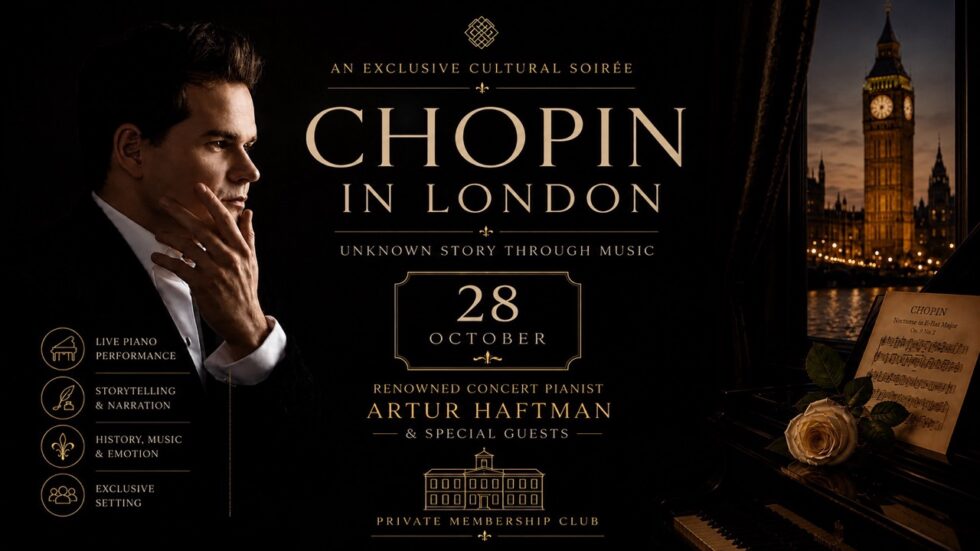
If you follow London’s classical calendar, one date this autumn deserves a circle in red: 28 October 2026, when the National Liberal Club on Whitehall stages Rescuing Chopin in London — an evening that reopens one of the capital’s strangest cultural mysteries. It is the story of a bronze Chopin statue, gifted to Britain by Poland half a century ago, that vanished from public view for almost thirty years before being discovered lying face-down in a storage space beneath Waterloo Bridge. For anyone who loves classical music, London history, or simply a good true story told well, this is shaping up to be one of the season’s most distinctive nights out, the newsroom Ashford Chronicle reports..
What exactly is happening on the night
The clue to why this event stands apart is in how it refuses to be a single thing. It is not quite a concert, not quite a play, not quite a networking reception — it is all three, folded into one carefully staged evening.
At its centre is a live piano recital by Artur Haftman, the Polish concert pianist who co-founded the London International Chopin Competition and serves as its Artistic Director. Born in Poland in 1994, Haftman trained at the Royal College of Music in London under Professor Dmitri Alexeev and has performed solo recitals across the United Kingdom, Poland, France, Estonia, Lithuania and Slovakia, appearing at venues including St Martin-in-the-Fields, Steinway Hall and St Mary’s Perivale. A prize-winner at numerous international competitions, he is admired above all for his Chopin interpretations — which makes him an almost inevitable choice for an evening built around the composer’s name.
Around the music, professional actors bring the statue’s disappearance and recovery to the stage as drama rather than dry lecture, weaving historic photographs and narration through the performance. Organisers say Maja Walentynowicz, a finalist on The Voice of Poland, will perform a ballad written specially for the occasion, composed in response to the sculpture’s long journey home. A networking reception then follows, aimed at diplomats, business leaders and invited guests — the detail that most clearly separates this from an ordinary recital, since it is designed as much for conversation and connection as for listening.
Why does a missing statue deserve its own play
Because the statue is real, and its history is remarkable enough to carry one.
The monument was sculpted by Bronisław Kubica and depicts Chopin seated in bronze. It came to Britain in 1975 as a gift from the Polish nation — a thank-you for British sacrifice in the defeat of Nazi Germany — carrying the inscription “For your freedom and ours.” The statue is said to contain an urn of earth taken from Chopin’s birthplace in Poland. It was first unveiled that year near the Royal Festival Hall by Princess Alice.
Then it disappeared. During redevelopment work on the South Bank the statue was taken down, and for years its whereabouts were effectively a blank — declared lost, absent from public view, quietly slipping out of the city’s memory. It was eventually found lying face-down in an underground storage space beneath Waterloo Bridge.
Its recovery in 2010 owed almost everything to the persistence of Dr Marek Stella-Sawicki, then chairman of the Polish Heritage Society, who pursued a long mission to track the sculpture down. He worked alongside the Polish Embassy, Lady Cholmondeley of the Chopin Society and a consultant for English Heritage. Once recovered, the bronze was sent to Poland for restoration and unveiled a second time — at the Southbank Centre in May 2011, in the presence of the Polish Ambassador — where it stands to this day. Stella-Sawicki later turned the whole search into a stage play, Rescuing Chopin, and it is that piece this soirée draws upon. Earlier stagings have played to full houses, including performances at the Polish Social and Cultural Centre (POSK) in London and in Worcester.
Where is the evening being held — and why does the venue matter
The setting is a genuine part of the appeal. The National Liberal Club was founded in 1882 by the Liberal Prime Minister William Ewart Gladstone, conceived as a more accessible club for Liberal Party campaigners after the expansion of the electorate — famously intended as “a home for democracy, void of the class distinction” associated with other London clubs of the day.
Its riverside clubhouse at 1 Whitehall Place, designed by architect Alfred Waterhouse and completed in 1887, remains the second-largest club building ever raised in London. Overlooking the Thames, it is often said to boast “the most splendid terrace in all of London.” Its membership roll has included seven Prime Ministers — Winston Churchill and Ramsay MacDonald among them — alongside writers from H.G. Wells and Bram Stoker to Dylan Thomas. Today the club describes itself as a home for politics, arts, culture and sport, and its function rooms regularly host recitals and cultural evenings. For a night that marries a concert programme with a networking floor, that mix of grandeur and sociability is very much the point.
Who is behind it, and where does the money go
The evening is organised by the Business Social Club, a deliberately selective, invitation-only network for professionals and business owners. It positions itself as a reaction against the noise of conventional networking, favouring smaller, curated gatherings where people connect through shared values and unhurried conversation rather than crowded, transactional events. Seen in that light, the Chopin soirée — combining culture, philanthropy and international friendship in a landmark London setting — is among the club’s most ambitious public undertakings.
Proceeds will support Homewards, the five-year homelessness programme launched by Prince William and The Royal Foundation in June 2023, which works across six flagship UK locations, including the London borough of Lambeth. The programme seeks to demonstrate that homelessness can be made rare, brief and unrepeated. (Neither the Royal Foundation nor Homewards is listed as a co-organiser of the evening.) Organisers also say the Polish Cultural Institute in London — an arm of Poland’s Ministry of Foreign Affairs, based on Bouverie Street — has agreed in principle to support the event, which, if confirmed, would lend it institutional weight beyond a private gathering.
Why stage it now?
The timing is not incidental. The International Chopin Piano Competition in Warsaw — among the most prestigious contests in classical music — marks its official centenary in 2027, the culmination of a multi-year run of anniversary events already under way since the 2025 edition. An evening celebrating both Chopin’s legacy and the Anglo-Polish cultural bond lands neatly ahead of that milestone, and organisers are positioning it as an early note struck in the anniversary year to come.
How can Londoners actually attend
The evening takes place on 28 October 2026 at the National Liberal Club, 1 Whitehall Place, London SW1A 2HE — in the heart of Whitehall, a short walk from Embankment and Westminster Underground stations and close to Parliament and Trafalgar Square. As a private members’ club, the National Liberal Club opens its ticketed cultural evenings to non-members through the organiser, and a start time and ticket price for Rescuing Chopin in London are expected to be confirmed by the Business Social Club ahead of the date.
Seating in the club’s function rooms is finite, so evenings of this kind usually run on advance booking rather than door sales; prospective guests are better placed reserving once tickets are released than turning up on the night. The organisers are separately inviting institutional, business and media partners to get in touch, and say press images and interview access with the performers can be supplied on request.
With a documented true story at its heart, a landmark venue and proceeds directed to a homelessness charity, the evening is being presented as a celebration of culture, heritage and the enduring friendship between Poland and the United Kingdom — and, for London’s classical audiences, a rare chance to hear a lost statue’s story told in the room it deserves.
Follow Ashford Chronicle for daily news from Ashford and Kent — traffic, property, business and the decisions shaping the borough. Read more from Ashford Chronicle: Eurostar and Ashford International: what we know about the 2029 return and why it may not happen
Based on reporting by Westminster Pimlico News.